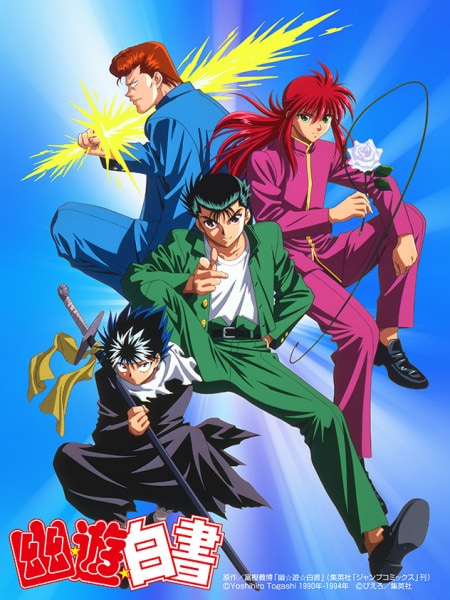
Yu Yu Hakusho
Where to watch
Summary
Yu Yu Hakusho is a foundational pillar of 90s shonen whose Dark Tournament arc remains a genre-defining benchmark for the tournament format, balancing high-stakes combat with genuine character interiority for its supporting cast. Togashi's writing is sharper than most of its contemporaries — Younger Toguro is a more thematically coherent villain than most shonen antagonists, and Sensui's Chapter Black arc engages with moral ambiguity in ways DBZ never attempted. The four-protagonist dynamic, particularly Hiei and Kurama's introductions as antiheroes with their own codes, established archetypes the genre still recycles. Its weaknesses are real, however: the Three Kings arc is a famously deflated ending, clearly the product of an exhausted author abandoning his own premise, and the animation quality is inconsistent outside the Dark Tournament's showcase fights. The power system, while characterful, is less inventive than Togashi's later Hunter x Hunter work would prove him capable of. Still, within shonen conventions it ranks among the most emotionally literate and tightly constructed series of its era, and its influence on Toonami-generation Western fans and on subsequent Jump rivalries (Sasuke, Killua, and countless others owe Hiei a debt) is difficult to overstate.
Criterion breakdown
Story & narrative
The four-arc structure escalates effectively from episodic Spirit Detective cases to the tournament-driven Dark Tournament (the show's peak), then the Chapter Black arc's morally complex Sensui conflict. However, the Three Kings arc is a notorious anticlimax — Togashi's waning interest shows in the rushed, talk-heavy resolution that abandons the demon world tournament's stakes with a time-skip and narration dump.
Character writing & growth
Yusuke's arc from delinquent to half-demon is grounded by genuine relationships, but the standout work is on the supporting cast: Hiei's Black Dragon reveal against Zeru and his bond with Yukina, Kurama's flashback to his mother Shiori, and Kuwabara's refusal to abandon his code even when outclassed by Risho or Elder Toguro. Sensui is a rare shonen villain whose ideology (the Chapter Black tapes, his multiple personalities) actually interrogates the protagonist's worldview rather than just opposing it.
Themes & emotional resonance
Younger Toguro's 'strength as addiction' arc and Sensui's disillusionment with humanity give the show genuine thematic weight beyond standard friendship-and-perseverance shonen fare. The Chapter Black arc's question of whether humans deserve protection is unusually pointed. The themes lose focus in the Three Kings arc, which gestures at demon politics without committing.
World-building & power system
Reikai/Makai/Ningenkai is a clean tripartite cosmology, and the spirit energy system has appealing specificity — Yusuke's Spirit Gun with limited shots, Kurama's plant-based techniques, Hiei's jagan and dragon. Still, the power system is largely conventional ki-blast shonen with personalized flourishes rather than a structurally inventive system like Hunter x Hunter's nen, which Togashi would later develop.
Animation & direction
Noriyuki Abe's direction gives the Dark Tournament fights real weight — Yusuke vs. Jin's aerial choreography and the Toguro final stand out for fluid key animation and dramatic lighting. Quality dips noticeably in the Sensui arc's middle episodes and the Three Kings arc looks visibly cheaper, with more stills and recycled cuts. Yoshihisa Hirano and Yusuke Honma's score, especially 'Smile Bomb' and 'Hohoemi no Bakudan,' elevates the direction considerably.
Cultural impact
A foundational Toonami-era gateway anime in the West alongside DBZ, and at home it normalized the tournament arc template that One Piece, Naruto, and Bleach would later refine. Hiei and Kurama essentially codified the 'cool rival duo' archetype that shonen has been copying for thirty years.
Synopsis (from MAL)
One fateful day, Yuusuke Urameshi, a 14-year-old delinquent with a dim future, gets a miraculous chance to turn it all around when he throws himself in front of a moving car to save a young boy. His ultimate sacrifice is so out of character that the authorities of the spirit realm are not yet prepared to let him pass on. Koenma, heir to the throne of the spirit realm, offers Yuusuke an opportunity to regain his life through completion of a series of tasks. With the guidance of the death god Botan, he is to thwart evil presences on Earth as a Spirit Detective. To help him on his venture, Yuusuke enlists ex-rival Kazuma Kuwabara, and two demons, Hiei and Kurama, who have criminal pasts. Together, they train and battle against enemies who would threaten humanity's very existence. [Written by MAL Rewrite]