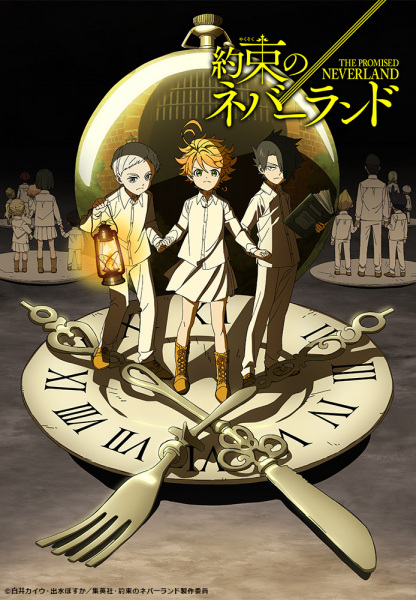
The Promised Neverland
Where to watch
Summary
The Promised Neverland season 1 is one of shonen's most successful experiments in genre fusion, swapping tournament arcs and power escalation for a tightly-wound psychological thriller built on intelligence rather than strength. Mamoru Kanbe's direction—the unsettling framing of Isabella, the muted color palette, Takahiro Obata's piercing score—elevates a strong premise into sustained dread, and the Norman-Emma-Ray dynamic gives the show a genuine strategic engine. Isabella stands among shonen's better antagonists precisely because her menace is intimate rather than spectacular. Its weaknesses are real: the younger orphans function as stakes rather than characters, Emma's idealism can feel schematic against Ray's sharper edges, and the worldbuilding is more promissory than substantive within these twelve episodes. The larger problem hovering over any evaluation is the franchise's collapse in season 2, which retroactively makes season 1 feel like an incomplete artifact rather than the opening of a great work. Judged purely on its own terms, however, it remains a landmark for demonstrating that shonen can sustain twelve episodes of thriller mechanics without a single fight scene, and its influence on the genre's willingness to embrace darker, smarter premises is undeniable.
Criterion breakdown
Story & narrative
Season 1's escape narrative is a masterclass in psychological thriller pacing, with the first episode's reveal of Conny's corpse and the tracker discovery in episode 2 establishing relentless tension. The cat-and-mouse plotting against Isabella—particularly the rope training, Norman's fake shipment in episode 10, and the final escape in episode 12—is meticulously constructed, though the show benefits enormously from ending where it does, before the manga's weaker arcs.
Character writing & growth
Norman, Emma, and Ray form a genuinely compelling strategic trio with distinct cognitive styles—Ray's calculated nihilism and double-agent reveal is the season's best character work. Isabella is a standout antagonist whose backstory in episode 11 reframes her into something tragic rather than monstrous. However, the younger orphans remain functional plot devices, and Emma's relentless optimism occasionally flattens her into an archetype rather than a person.
Themes & emotional resonance
The show interrogates manufactured innocence, the ethics of sacrificing the few for the many (Ray's utilitarianism vs. Emma's idealism), and livestock-as-metaphor for systems that commodify children. The Mama-as-product-of-the-system theme lands hard in Isabella's lullaby scene, though the philosophical weight is sometimes undercut by the need to hit thriller beats.
World-building & power system
The demon-farm premise is genuinely fresh for shonen, inverting the typical battle-shonen power structure into a survival puzzle where intelligence is the only weapon. However, season 1 deliberately withholds worldbuilding—the demons, the broader farm system, and William Minerva are tantalizing hints rather than developed lore, which works for tension but leaves the system underdeveloped on its own merits.
Animation & direction
Mamoru Kanbe's direction is the show's secret weapon—the use of inverted camera angles when Isabella enters frame, the sickly green lighting in the gate sequence, and the sound design around Conny's teddy bear create sustained dread rather than relying on action spectacle. CloverWorks delivers clean character animation, though the show is conservative with movement, prioritizing composition over kinetic flair.
Cultural impact
The 2019 debut was a major Jump crossover hit and brought legitimate thriller sensibilities to a shonen audience, earning live-action adaptations and broad international streaming buzz. However, the catastrophic season 2—which skipped major arcs and damaged the franchise's reputation—has measurably blunted its long-term standing relative to peers like Demon Slayer or Jujutsu Kaisen.
Synopsis (from MAL)
Surrounded by a forest and a gated entrance, the Grace Field House is inhabited by orphans happily living together as one big family, looked after by their "Mama," Isabella. Although they are required to take tests daily, the children are free to spend their time as they see fit, usually playing outside, as long as they do not venture too far from the orphanage—a rule they are expected to follow no matter what. However, all good times must come to an end, as every few months, a child is adopted and sent to live with their new family, never to be heard from again. However, the three oldest siblings have their suspicions about what is actually happening at the orphanage, and they are about to discover the cruel fate that awaits the children living at Grace Field, including the twisted nature of their beloved Mama. [Written by MAL Rewrite]