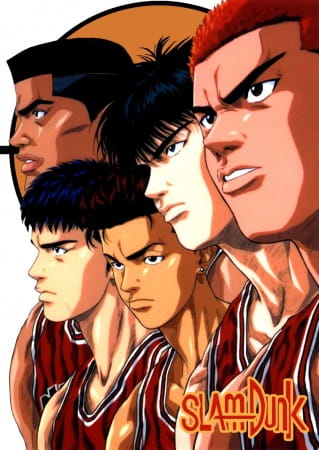
Slam Dunk
Where to watch
Summary
Slam Dunk stands as a foundational pillar of sports shonen, distinguished by Takehiko Inoue's commitment to character interiority over tournament mechanics. Sakuragi is a rare protagonist whose initial cluelessness about his sport is played for genuine character development rather than gag fodder — his journey from rebound-counting novice to someone who declares basketball his identity is earned across 101 episodes of incremental growth. The supporting cast, particularly Mitsui's redemption arc and Akagi's burdened captaincy, gives Shohoku ensemble depth that most shonen teams lack. Thematically it elevates effort, second chances, and the humbling nature of competition without resorting to mystical power-ups or destiny rhetoric. Its weaknesses are real, however: Toei's 1993 animation budget shows constantly, with stiff game sequences that undersell Inoue's dynamic source art, and the anime's abrupt ending before the legendary Sannoh match leaves the adaptation fundamentally incomplete — viewers must read the manga or wait for The First Slam Dunk film for closure. Within shonen conventions it ranks among the genre's most influential works, particularly for its cultural footprint across Asia, but the unfinished adaptation prevents the TV series itself from achieving the definitive status its narrative deserves.
Criterion breakdown
Story & narrative
The progression from Sakuragi's romantic delusion to genuine basketball obsession is paced with unusual patience for a shonen sports series, building through the Ryonan practice match, the Interhigh prefectural qualifiers, and culminating in the Kainan and Shoyo games. However, the anime infamously ends mid-arc before the Sannoh match, leaving the narrative incomplete — a structural weakness that significantly hampers it compared to finished works like Hajime no Ippo's early run.
Character writing & growth
Sakuragi's arc from delinquent poser to genuine rebounder who finds identity in the sport is one of shonen's finest character transformations, and the rivalry with Rukawa avoids the typical 'destined friends' trope by remaining genuinely antagonistic. Supporting players like Mitsui (whose flashback episode about returning to basketball is a series highlight), Miyagi, and Akagi each receive substantive backstories rather than functioning as mere set dressing.
Themes & emotional resonance
The show interrogates passion vs. talent, redemption (Mitsui's 'I want to play basketball' scene), and the dignity of effort without slipping into pure inspirational platitudes. Sakuragi's gradual respect for the sport he initially mocked carries genuine emotional weight, though the anime's truncation prevents the fullest payoff of these themes that the manga delivers.
World-building & power system
As a grounded sports series there's no power system to evaluate — the 'world-building' lies in the high school basketball circuit hierarchy (Kainan as perennial champions, Ryonan as rising threat, Sannoh as ultimate boss). It's well-constructed within realism but lacks the inventive mechanical depth this criterion typically rewards in shonen; the basketball itself is depicted accurately rather than fantastically exaggerated like Kuroko no Basket.
Animation & direction
Toei's 1993 TV production is visibly budget-constrained, with frequent still frames, recycled motion cuts during games, and inconsistent character models — the Shoyo match in particular suffers from limited animation during crucial plays. Inoue's expressive character designs survive translation well and key emotional beats are directed with strong composition, but the game choreography rarely matches the manga's kinetic paneling.
Cultural impact
Slam Dunk is single-handedly credited with popularizing basketball across Japan, the Philippines, China, and much of East Asia, driving youth participation rates measurably upward through the 1990s. Its influence permeates every subsequent basketball manga and sports shonen broadly, and the 2022 First Slam Dunk film reignited global attention decades later.
Synopsis (from MAL)
Hanamichi Sakuragi, infamous for his temper, massive height, and fire-red hair, enrolls in Shohoku High, hoping to finally get a girlfriend and break his record of being rejected 50 consecutive times in middle school. His notoriety precedes him, however, leading to him being avoided by most students. Soon, after certain events, Hanamichi is left with two unwavering thoughts: "I hate basketball," and "I desperately need a girlfriend." One day, a girl named Haruko Akagi approaches him without any knowledge of his troublemaking ways and asks him if he likes basketball. Hanamichi immediately falls head over heels in love with her, blurting out a fervent affirmative. She then leads him to the gymnasium, where she asks him if he can do a slam dunk. In an attempt to impress Haruko, he makes the leap, but overshoots, instead slamming his head straight into the blackboard. When Haruko informs the basketball team's captain of Hanamichi's near-inhuman physical capabilities, he slowly finds himself drawn into the camaraderie and competition of the sport he had previously held resentment for. [Written by MAL Rewrite]