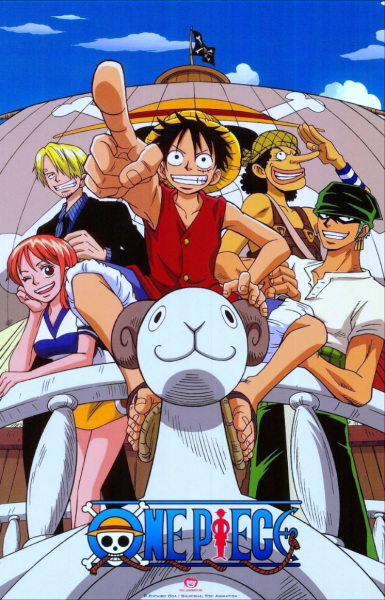
One Piece
Where to watch
Summary
One Piece is the rare long-runner whose ambition matches its length — Oda's interconnected worldbuilding and 25-year foreshadowing payoffs represent shonen's most sustained narrative achievement. The Devil Fruit system remains the genre's most inventive power framework, prioritizing creative matchups over numerical escalation, and the Straw Hats' individual backstories (Nami, Robin, Brook, Sanji) deliver some of shonen's most earned emotional moments. Thematically, its consistent commitment to freedom and anti-tyranny gives even comedic arcs underlying weight. The weaknesses are real and worth naming: Toei's animation has been inconsistent for two decades, with infamous pacing issues stretching single fights across months of episodes, and tonal management sometimes undercuts serious beats with gag reactions. Luffy as a protagonist is philosophically static — the show grows around him rather than through him. Recent direction under talents like Megumi Ishitani has elevated the visual ceiling considerably, but viewers must commit to a notoriously slow burn. Within shonen conventions, it is a foundational work whose cultural footprint and worldbuilding ambition compensate for adaptation flaws. It is not flawless, but it is essential — the closest thing the genre has to a defining magnum opus.
Criterion breakdown
Story & narrative
Oda's long-game plotting is exceptional within shonen — setups from Romance Dawn pay off hundreds of episodes later (Bink's Sake in Brook's backstory, the Gorosei foreshadowing). Arcs like Water 7/Enies Lobby and Marineford demonstrate masterful escalation and consequence. However, Toei's adaptation suffers from chronic pacing bloat, with arcs like Dressrosa and Wano padded to the point of momentum collapse, and filler episodes (G-8 aside) dilute the narrative drive.
Character writing & growth
Each Straw Hat receives a dedicated 'join' arc with thematic weight — Nami's Arlong Park breakdown and Robin's 'I want to live' at Enies Lobby remain genre benchmarks for emotional payoff. The villains (Crocodile, Doflamingo, Katakuri) are ideologically distinct rather than power-tier filler. Luffy himself, however, grows less than his crew — his core philosophy is essentially static from Episode 1, which is both a strength and a writing limitation.
Themes & emotional resonance
Freedom, found family, and resistance against systemic injustice run through every arc — Fishman Island's racism, Dressrosa's tyranny, Wano's class oppression. The Ohara flashback and Otama/Yasuie's deaths land with genuine weight. Occasionally undercut by tonal whiplash, where comedic mugging interrupts otherwise devastating moments (a Toei direction choice as much as Oda's writing).
World-building & power system
The Devil Fruit system is arguably the most creative power framework in shonen — Logia/Zoan/Paramecia distinctions enable wildly varied fights rather than escalating numerical power. The Grand Line's island-by-island structure (Skypiea, Thriller Bark, Wano) lets Oda build distinct cultures with their own aesthetics and politics. Haki was retrofitted somewhat clumsily but largely integrated.
Animation & direction
Toei's production is the show's weakest link — inconsistent in-betweens, recycled reaction shots, and notorious slow-motion padding (Luffy reaching the gate at Marineford). Recent arcs (Wano, Episode 1015 by Megumi Ishitani) show dramatic improvement with bold compositions, but baseline quality from the East Blue and Alabasta eras is visually dated and stiff compared to contemporaries.
Cultural impact
The best-selling manga in history, with the anime serving as a global gateway — the Marineford arc and Wano premiere were cultural events. It has defined the shonen pirate subgenre wholesale and the Netflix live-action's success cemented its mainstream Western penetration. Definitive of the medium's commercial and cultural ceiling.
Synopsis (from MAL)
Barely surviving in a barrel after passing through a terrible whirlpool at sea, carefree Monkey D. Luffy ends up aboard a ship under attack by fearsome pirates. Despite being a naive-looking teenager, he is not to be underestimated. Unmatched in battle, Luffy is a pirate himself who resolutely pursues the coveted One Piece treasure and the King of the Pirates title that comes with it. The late King of the Pirates, Gol D. Roger, stirred up the world before his death by disclosing the whereabouts of his hoard of riches and daring everyone to obtain it. Ever since then, countless powerful pirates have sailed dangerous seas for the prized One Piece only to never return. Although Luffy lacks a crew and a proper ship, he is endowed with a superhuman ability and an unbreakable spirit that make him not only a formidable adversary but also an inspiration to many. As he faces numerous challenges with a big smile on his face, Luffy gathers one-of-a-kind companions to join him in his ambitious endeavor, together embracing perils and wonders on their once-in-a-lifetime adventure. [Written by MAL Rewrite]