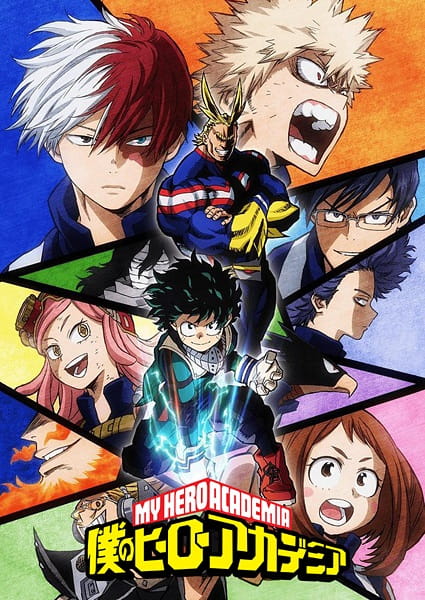
My Hero Academia
Where to watch
Summary
Season 2 is My Hero Academia at its most confident and arguably its peak, transforming what could have been a stock tournament arc into a character-driven examination of inherited power, paternal abuse, and the commodification of heroism. Todoroki's reckoning with Endeavor and Stain's ideological challenge give the season real thematic teeth, while Bones delivers some of the most memetic action cuts in late-2010s shonen, scored by Yuki Hayashi's now-iconic brass themes. Within shonen conventions it ranks highly: the Sports Festival's bracket structure earns its runtime by using each match to develop a different classmate, and the Stain arc proves the show can operate outside school walls. Weaknesses persist—Mineta's perverted gags remain tonally toxic, the Final Exams arc deflates after Stain's larger stakes, the One For All mechanics stay vague, and the enormous Class 1-A roster means several students (Sato, Koda, Shoji) get little more than quirk demonstrations. Still, this is the season that justified the hype, turned Todoroki into a cultural fixture, and established MHA as the defining Jump property of its generation, even if subsequent seasons would struggle to sustain this density.
Criterion breakdown
Story & narrative
Season 2 is structurally the strongest stretch of MHA, with the Sports Festival arc using a tournament framework not as filler but as a vehicle for character revelation—Todoroki's confrontation with Endeavor in the stands during the Midoriya match is a genuine narrative climax. The Hero Killer Stain arc that follows pivots cleanly into ideological conflict, though the Final Exams arc loses some momentum by reverting to school-tier stakes after Stain's larger thematic provocations.
Character writing & growth
Todoroki's arc is the season's spine and one of the best single-arc character overhauls in modern shonen—his 'It's your power' moment in the Midoriya fight recontextualizes his entire ice/fire dichotomy as trauma rather than gimmick. Iida's revenge arc gives a normally comic-relief side character real weight, and even Bakugo's gold-medal tantrum is character-consistent rather than gratuitous. Mineta remains a persistent drag.
Themes & emotional resonance
Stain's critique of fame-chasing heroism and Endeavor's poisonous ambition give the season a thematic backbone that S1 lacked, interrogating what 'hero' actually means within the licensed-pro system. The 'borrowed power vs. inherited burden' thread through Midoriya and Todoroki resonates, though the show occasionally undercuts its own questions with conventional triumphalist beats.
World-building & power system
The hero-license economy, sidekick rankings, and pro-hero agency internships flesh out the society in concretely bureaucratic ways uncommon in superpowered shonen. One For All's stockpile mechanic remains thin this season, but Quirk variety in the Sports Festival (Ojiro, Shinso's brainwashing, Tokoyami's Dark Shadow) is inventive even if many quirks are clearly designed for visual differentiation rather than systemic logic.
Animation & direction
Bones and director Kenji Nagasaki deliver standout cuts—Yutapon-cube debris in the Midoriya vs. Todoroki clash, the impact frames in Iida/Midoriya/Todoroki vs. Stain, and Yuki Hayashi's brass-heavy 'You Say Run' scoring elevate climaxes considerably. Mid-tier episodes show the Bones budget stretching thin with static reaction shots, but peak moments are genre-defining.
Cultural impact
Season 2 is when MHA broke out internationally, with the Todoroki fight and 'Plus Ultra' becoming convention-circuit shorthand and the show positioned as the heir-apparent to the Big Three. Its Western superhero/shonen fusion influenced subsequent Jump titles' marketing globally, though its long-term canonical weight is still being adjudicated.
Synopsis (from MAL)
At UA Academy, not even a violent attack can disrupt their most prestigious event: the school sports festival. Renowned across Japan, this festival is an opportunity for aspiring heroes to showcase their abilities, both to the public and potential recruiters. However, the path to glory is never easy, especially for Izuku Midoriya—whose quirk possesses great raw power but is also cripplingly inefficient. Pitted against his talented classmates, such as the fire and ice wielding Shouto Todoroki, Izuku must utilize his sharp wits and master his surroundings to achieve victory and prove to the world his worth. [Written by MAL Rewrite]