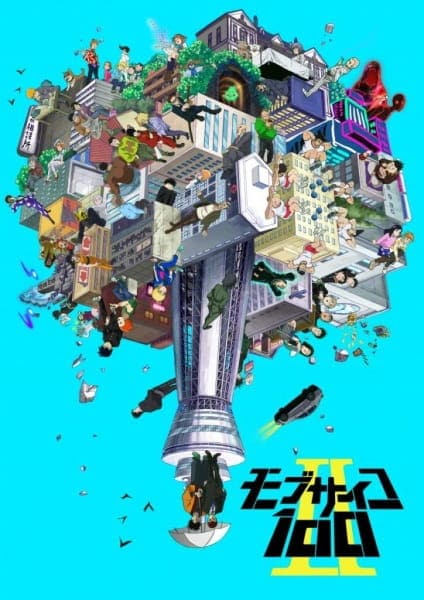
Mob Psycho 100
Where to watch
Summary
Mob Psycho 100 II is a rare shonen sequel that surpasses its predecessor by leaning harder into character interiority rather than escalating spectacle for its own sake — though the spectacle, courtesy of Bones' animator-forward production, is genuinely staggering. The Mogami arc and Reigen's exposure arc represent some of the most thematically rigorous storytelling in modern shonen, prioritizing the question of how a nearly omnipotent child chooses to be ordinary and kind over standard tournament-style escalation. Its central inversion — that emotional repression, not training, fuels power — keeps it conceptually distinct from peers like My Hero Academia or Jujutsu Kaisen. Weaknesses exist: the Claw organization remains a thinly drawn antagonist apparatus, the early monster-of-the-week episodes feel like throat-clearing before the season's real concerns emerge, and the broader cosmology is gestural rather than systematic. The show is also less culturally pervasive than its quality warrants, remaining a craft-community touchstone rather than a mainstream phenomenon. Within shonen conventions, however, its character writing, thematic discipline, and directorial ambition make it one of the genre's most fully realized works of the late 2010s, even if it stops short of being definitive of the medium.
Criterion breakdown
Story & narrative
Season 2's narrative is exceptionally tight, with the Mogami arc (episodes 5-6) functioning as a self-contained psychological horror that recontextualizes Mob's worldview, and the Divine Tree/Claw arc building to the '???%' confrontation with genuine stakes. The pacing occasionally suffers in the early episodes' monster-of-the-week structure before the season finds its spine, but the payoff in the final three episodes is among the most coherent climaxes in shonen.
Character writing & growth
This is the show's strongest dimension: Reigen's fall and redemption arc in episodes 7-8, where the press conference exposes him as a fraud before Mob publicly affirms his belief, is unusually mature character writing for shonen. Mob's confrontation with Mogami forces him to articulate why he refuses to use power as leverage, and even side characters like Ritsu, Teru, and Dimple receive earned development rather than power-up checkpoints.
Themes & emotional resonance
ONE's thesis — that psychic power is irrelevant to self-worth and that kindness must be chosen, not inherited — is dramatized rather than monologued. The Mogami arc's interrogation of whether suffering justifies cruelty, and Reigen's insistence that being a good person is a separate skill from being talented, gives the show thematic weight that most shonen contemporaries lack.
World-building & power system
The percentage-based emotional power system remains conceptually elegant — power tied to repression rather than training hours inverts standard shonen logic. However, the Claw organization feels underdeveloped as an antagonistic structure compared to peer works, and the spirit/esper cosmology is more atmospheric than rigorously built out.
Animation & direction
Bones and director Yuzuru Tachikawa push the sakuga ceiling with the Mob vs. Koyama fight, the broccoli sequence, and the climactic ???% battle, all of which deploy paint-on-glass textures, smear frames, and elastic character acting rarely seen in TV anime. The direction's willingness to shift art styles mid-scene for emotional emphasis (Mogami's distorted memories, Mob's dissociation) is virtuosic.
Cultural impact
While never approaching Demon Slayer or JJK in mainstream penetration, Mob Psycho II is canonized within the sakuga-literate community and frequently cited as a benchmark for adaptation fidelity and animator-driven production. Its influence is more on craft discourse than on broader pop culture.
Synopsis (from MAL)
Shigeo "Mob" Kageyama is now maturing and understanding his role as a supernatural psychic that has the power to drastically affect the livelihood of others. He and his mentor Reigen Arataka continue to deal with supernatural requests from clients, whether it be exorcizing evil spirits or tackling urban legends that haunt the citizens. While the workflow remains the same, Mob isn't just blindly following Reigen around anymore. With all his experiences as a ridiculously strong psychic, Mob's supernatural adventures now have more weight to them. Things take on a serious and darker tone as the dangers Mob and Reigen face are much more tangible and unsettling than ever before. [Written by MAL Rewrite]