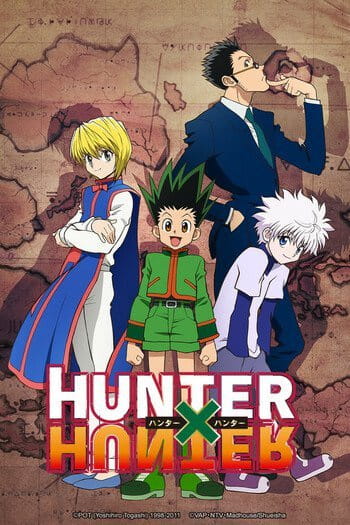
Hunter × Hunter (2011)
Where to watch
Summary
Hunter × Hunter (2011) is widely regarded as shonen's most intellectually ambitious mainstream entry, and the Madhouse adaptation gives Togashi's manga the disciplined direction it deserves. Its strengths are structural: each arc operates in a different genre register, the Nen system rewards tactical creativity over power escalation, and Killua's character arc is among the best in the medium. The Chimera Ant arc — particularly the Meruem-Komugi relationship and Gon's horrifying transformation — pushes shonen into territory most series avoid, interrogating violence, obsession, and humanity with unusual rigor. The show is not flawless. The Chimera Ant arc's reliance on heavy narration and static frames reflects production limits and tests viewer patience. Kurapika and Leorio largely vanish after Yorknew, leaving the central quartet imbalanced. The series ends mid-story with the Dark Continent voyage barely begun, an artifact of Togashi's hiatuses rather than authorial design. Animation, while well-directed, is not consistently spectacular outside marquee fights. Still, within shonen conventions, it is among the genre's most complete artistic statements — a series that takes the form seriously as a vehicle for moral and structural experimentation rather than escalation alone.
Criterion breakdown
Story & narrative
Togashi's arc structure is remarkably varied — the Hunter Exam functions as tournament shonen, Yorknew pivots into heist/mafia thriller, Greed Island plays as game-mechanics deconstruction, and Chimera Ant escalates into political-philosophical war narrative. The Chimera Ant arc in particular sustains genuine dread and moral ambiguity rarely attempted in Jump, though its narration-heavy pacing in the 120s drags considerably, and the post-Election epilogue feels like an unresolved pause rather than an ending.
Character writing & growth
Killua's arc from sheltered assassin to someone capable of choosing Gon over his family is the spine of the series, and Gon's terrifying regression at Pitou crystallizes how his single-minded cheer was always a warning sign, not a virtue. Meruem and Komugi's relationship is one of shonen's finest character transformations. Kurapika and Leorio thin out badly after Yorknew, and the Phantom Troupe members are more iconic than deeply written.
Themes & emotional resonance
The show interrogates obsession, the cost of revenge (Kurapika's chains literally shortening his life), and what separates human from monster — Meruem's question of 'what am I?' resonates harder than most shonen villain arcs. Gon's selfishness being framed as a flaw, not a strength, is genuinely subversive for the genre.
World-building & power system
Nen is arguably the most rigorously constructed power system in shonen — the six types, vows-and-restrictions trade-offs, and Hatsu specificity create fights won by ingenuity rather than escalation (Kurapika vs. Uvogin, Knuckle's APR, Morel's smoke). The Dark Continent setup and Hunter Association politics suggest worldbuilding depth most shonen never approach.
Animation & direction
Madhouse delivers strong direction with a clean, slightly storybook palette suited to Gon's perspective, and standout sequences like Gon vs. Hisoka in Heavens Arena, the Yorknew auction night, and the Royal Guard fights are excellent. However, much of the Chimera Ant arc relies on still frames and extended narration to compensate for production strain, and ordinary episodes look merely competent.
Cultural impact
While not the genre-defining juggernaut of Naruto or One Piece in mainstream reach, HxH 2011 is the connoisseur's shonen — consistently topping critic and fan 'best of' lists, and its Chimera Ant arc is routinely cited as a benchmark for what serialized shonen storytelling can achieve. Its influence is visible in the ambitions of later works like Jujutsu Kaisen.
Synopsis (from MAL)
Hunters devote themselves to accomplishing hazardous tasks, all from traversing the world's uncharted territories to locating rare items and monsters. Before becoming a Hunter, one must pass the Hunter Examination—a high-risk selection process in which most applicants end up handicapped or worse, deceased. Ambitious participants who challenge the notorious exam carry their own reason. What drives 12-year-old Gon Freecss is finding Ging, his father and a Hunter himself. Believing that he will meet his father by becoming a Hunter, Gon takes the first step to walk the same path. During the Hunter Examination, Gon befriends the medical student Leorio Paladiknight, the vindictive Kurapika, and ex-assassin Killua Zoldyck. While their motives vastly differ from each other, they band together for a common goal and begin to venture into a perilous world. [Written by MAL Rewrite]