Hikaru no Go
Where to watch
Summary
Hikaru no Go is notable within shonen for proving that a tournament structure can be built around an intellectual game with almost no visual spectacle, sustained entirely by character interiority and rivalry. Obata's character designs and Hotta's writing give the Sai-Hikaru-Akira triangle a tragic dimension uncommon in Jump properties: this is a shonen where the mentor's departure is not a power-up but a wound the protagonist must learn to carry. The pro exam and Insei arcs model a slow-burn meritocracy that feels closer to a workplace drama than a battle manga, and the show's cultural footprint — a verifiable surge in youth go participation across Japan, Korea, and China — is among the most concrete real-world impacts any shonen has produced. Its weaknesses are real: the post-Sai recovery is brilliant but the Hokuto Cup finale feels grafted on and ends without proper resolution to the Hikaru-Akira game the entire series has been building toward. Pierrot's animation is functional rather than expressive, leaning on storyboarding tricks to dramatize stillness. Yet within shonen, almost nothing else has used the form's conventions to tell so quiet and grief-shaped a story.
Criterion breakdown
Story & narrative
The narrative arc from Hikaru's reluctant proxy-playing to his agonizing pursuit of Sai's shadow after the Sai disappearance arc is one of shonen's most emotionally coherent structures. The Insei and Pro Exam arcs build stakes through accumulated study rather than escalating threat, which is rare. However, the final Hokuto Cup material feels rushed and tonally separate from the elegiac mid-series climax, leaving the show slightly imbalanced in its back half.
Character writing & growth
Hikaru's transformation from a bratty middle-schooler riding Sai's talent to a player who insists on his own moves is one of the most carefully paced protagonist arcs in shonen. Akira Touya works because his obsession with Hikaru's hidden strength is mutual and asymmetric, and side characters like Waya, Isumi, and Ogata get real interior lives. Sai's grief over being a vessel rather than a player gives the show its emotional spine — few shonen mentors are written with this much pathos.
Themes & emotional resonance
The 'connecting the distant past to the far future' through the eternal pursuit of the Hand of God is articulated with unusual restraint for shonen. Hikaru's post-Sai depression arc — where he literally cannot bring himself to touch a goban — treats loss and inheritance with adult seriousness, and the Sai-in-Hikaru's-moves revelation lands as genuine catharsis rather than fanservice.
World-building & power system
Go is not a 'power system' in the typical sense, and the show wisely refuses to invent flashy techniques, instead building tension through ranking systems, insei culture, and the pro exam pipeline. The Heian-era framing through Sai and the Shusaku historical connection enrich what would otherwise be a sports-procedural setting. The trade-off is that viewers who can't read board states must trust the characters' reactions, which limits visceral payoff.
Animation & direction
Pierrot's direction under Tetsuya Endo finds remarkable visual tension in a game of two people sitting still — close-ups on stones being placed, the snap of the goke, and the use of color (Sai's purples vs. Hikaru's yellows) carry enormous weight. The animation itself is modest TV-quality 2001 work with frequent still frames, and later episodes show clear budget fatigue, but the storyboarding compensates.
Cultural impact
The show single-handedly triggered a documented go boom among Japanese and East Asian youth, flooding go schools with children and revitalizing a graying game — a measurable real-world impact almost no other shonen can claim. Its influence on the 'niche hobby shonen' subgenre (Chihayafuru, March Comes in Like a Lion adjacent works) is substantial.
Synopsis (from MAL)
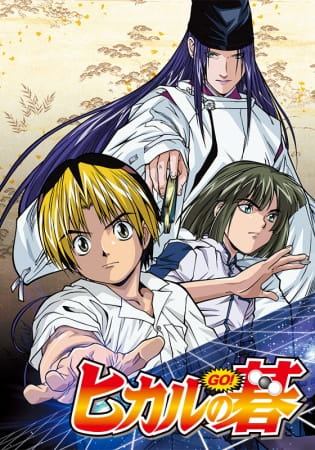
While searching through his grandfather's attic, Hikaru Shindou stumbles upon an old go board. Touching it, he is greeted by a mysterious voice, and soon after falls unconscious. When he regains his senses, he discovers that the voice is still present and belongs to Fujiwara no Sai, the spirit of an ancient go expert. A go instructor for the Japanese Emperor in the Heian Era, Sai's passion for the game transcends time and space, allowing him to continue playing his beloved game as a ghostly entity. Sai's ultimate goal is to master a divine go technique that no player has achieved so far, and he seeks to accomplish this by playing the board game through Hikaru. Despite having no interest in board games, Hikaru reluctantly agrees to play, executing moves as instructed by Sai. However, when he encounters the young go prodigy Akira Touya, a passion for the game is slowly ignited within him. Inspired by his newfound rival, Hikaru's journey into the world of go is just beginning. [Written by MAL Rewrite]