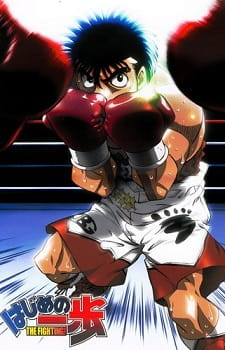
Hajime no Ippo
Where to watch
Summary
Hajime no Ippo (2000) is the definitive boxing shonen and arguably the high-water mark of sports anime from its era. Its strengths are the patient construction of Ippo's identity through the ring, a supporting cast with genuine inner lives (Takamura's professionalism behind the gag persona, Miyata's exiled-prodigy arc, Kamogawa's wartime regret), and Madhouse's willingness to let Ippo lose the Date fight — a structural choice that gives the entire series stakes most shonen avoid. The physicality is sold through punchy sound design and selective animation peaks rather than constant sakuga, which works for the ring but exposes the show's modest TV budget during training and comedy stretches. Weaknesses include a reliance on the opponent-of-the-week formula in the middle third, Aoki and Kimura being flanderized into comic relief at the expense of their own fight arcs, and a narrow thematic scope inherent to its single-sport focus. Within shonen, it stands apart by treating its protagonist's emotional question — what does it mean to be strong? — with sustained seriousness across 75 episodes, refusing the easy power-creep answer most of the genre defaults to.
Criterion breakdown
Story & narrative
The fight-to-fight progression is exceptionally well-paced, with the Date Eiji title match standing as one of shonen's finest single bouts — Ippo's loss to Date is earned, devastating, and structurally bold for a protagonist's first title shot. The Sendo rivalry and the climactic Featherweight title fight provide a satisfying arc-long crescendo. However, the show leans heavily on the tournament-of-opponents formula and some mid-series fights (Saeki, Volg's opponents in the Class A tournament) feel like padding rather than narrative escalation.
Character writing & growth
Ippo's transformation from bullied introvert to Featherweight champion is patient and earned, with his 'what does it mean to be strong?' question giving him genuine interiority rare in sports shonen. The supporting cast — Takamura's gravitas masked by gag-character vulgarity, Miyata's tragic counter-puncher pride, Kamogawa's regret-laden mentorship tied to the Nekota flashback — are unusually well-developed. Aoki and Kimura occasionally slide too far into comic relief, undercutting their own fight arcs.
Themes & emotional resonance
The repeated meditation on strength, sacrifice, and the loneliness of the ring gives the show a thematic weight most shonen lack — Takamura's bag-work monologues and Kamogawa's WWII-era backstory with Nekota add genuine pathos. The bullying-to-self-actualization arc resonates without ever becoming saccharine. It loses some thematic momentum in the middle stretch where fights become mechanical rather than thematically motivated.
World-building & power system
The 'power system' here is real boxing, and the show's commitment to depicting actual technique — the Dempsey Roll, gazelle punches, counters, in-fighting versus out-boxing — functions as a uniquely grounded shonen 'power system.' Each opponent represents a distinct style, which substitutes effectively for fantastical abilities. It's narrow by design, though, lacking the broader world-building scope that genre-defining shonen often attain.
Animation & direction
Madhouse's direction under Satoshi Nishimura uses impact frames, sound design (the bass-heavy punch foley is iconic), and selective high-frame-count sequences to sell weight in the ring — the Date fight and Sendo rematch are standouts. Outside of major bouts, however, the animation is noticeably economical, with recycled reaction shots and static training montages. Character designs are distinctive but the show's late-90s/early-2000s palette has aged.
Cultural impact
Widely considered the benchmark boxing anime and a gateway sports shonen alongside Slam Dunk, Ippo has sustained a multi-decade fandom and three anime continuations. Its influence on later sports series (Megalo Box openly homages it) and its consistent top-tier MAL standing speak to durable impact, though it never broke into mainstream Western consciousness the way Big Three shonen did.
Synopsis (from MAL)
In his father's absence, teenager Ippo Makunouchi works hard to help his mother run her fishing boat rental business. Ippo's timid nature, his lack of sleep, and the sea smell make him an easy target for relentless bullies who leave him bruised and beaten on a daily basis. Mamoru Takamura, an up-and-coming boxer, rescues Ippo from a violent after-school incident and takes him back to the Kamogawa Boxing Gym for recovery. Takamura and his fellow boxers, Masaru Aoki and Tatsuya Kimura, are stunned by Ippo's powerful punches—a result of strong muscles developed through years serving his physically taxing family business. Following brief training under Takamura, Ippo impresses the other boxers in a practice match against prodigy Ichirou Miyata. He gains a rival in Miyata and a coach in Genji Kamogawa, the gym owner and a former boxer himself. As Ippo takes the first steps in his official boxing career, he faces off against a series of challenging opponents, each more powerful than the last. Victory, loss, and a cycle of dedicated training await Ippo on his journey to achieve greatness. With his tough body and unstoppable fighting spirit, the kind young man seeks to take on the world. [Written by MAL Rewrite]