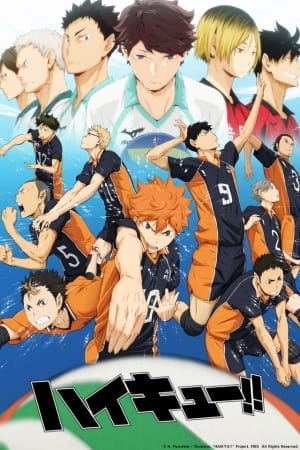
Haikyuu!!
Where to watch
Summary
Haikyuu!!'s first season is a near-textbook execution of sports shonen fundamentals, distinguished less by innovation than by craft. Within the genre, it stands out for taking ensemble character work seriously — Karasuno's six starters all receive meaningful interiority within 25 episodes, which is rare in a category that typically orbits a single protagonist. Furudate's actual knowledge of volleyball gives the 'technique reveals' weight that pseudo-scientific shonen power systems often lack: the freak quick works because it's mechanically plausible, not because of escalating power levels. Director Mitsunaka's spatial discipline keeps rallies legible, and the Aoba Johsai loss is one of the better uses of defeat-as-fuel in modern shonen. Weaknesses are real if modest: Hinata is the least developed of the leads, the Interhigh arc is paced more tightly than it should be, and the rival-school cast in season one is thinner than what later seasons deliver. It also lacks the thematic density or world-building ambition of genre-defining works, which caps its ceiling. Still, it's the show that proved a non-combat shonen could command Jump-tier emotional investment, and it set the template for the decade's sports-anime renaissance.
Criterion breakdown
Story & narrative
Season 1's arc structure is exemplary for sports shonen: the Hinata-Kageyama rivalry-turned-partnership culminates cleanly in the freak quick-attack, and the Aoba Johsai loss followed by the Date Tech 'Iron Wall' match gives the season a satisfying rise-fall-rise rhythm. However, the early episodes lean heavily on standard underdog beats, and the Interhigh preliminaries arc feels rushed compared to later seasons' tournament pacing.
Character writing & growth
Even in 25 episodes, Furudate distributes development unusually well — Tsukishima's prickly distance, Daichi's quiet authority, Sugawara's displacement anxiety as Kageyama rises, and Asahi's return arc all land with specificity. Kageyama's shift from 'King of the Court' to genuine setter is the season's spine, though Hinata himself remains the most archetypal element: loud, hungry, and relatively static beyond his court IQ growing.
Themes & emotional resonance
The 'you can't fly alone' thesis is delivered with restraint — the crows imagery, Ukai's mantra about connecting the ball, and Asahi's fear of letting teammates down all reinforce interdependence without preaching. It lacks the heavier thematic ambition of something like Hunter x Hunter, but its emotional sincerity around teamwork and the dignity of effort is genuinely affecting.
World-building & power system
There is no 'power system' to speak of — Haikyuu's innovation is treating real volleyball tactics (synchronized attacks, blocking reads, libero rotations) as if they were techniques, and Furudate's grasp of the sport is notably rigorous. The school-rivalry ecosystem (Seijoh, Nekoma, Date Tech) is well-sketched but conventional for the sports subgenre, and within shonen broadly this category penalizes it.
Animation & direction
Susumu Mitsunaka's direction excels at spatial clarity — you always know where the ball is, where each blocker stands, and how a play develops, which is harder than it looks. The Kageyama-Hinata first successful quick in episode 9 and the climactic Seijoh match use speed lines, impact frames, and sudden silence effectively, though some mid-season rallies recycle reaction-shot cutaways to pad tension.
Cultural impact
Haikyuu single-handedly revived mainstream interest in sports anime in the mid-2010s and is credited with measurable spikes in Japanese high school volleyball club enrollment. It became Jump's flagship non-battle sports title alongside Kuroko no Basket and remains a fandom touchstone, though its global footprint is narrower than Naruto/Bleach-tier properties.
Synopsis (from MAL)
Ever since having witnessed the "Little Giant" and his astonishing skills on the volleyball court, Shouyou Hinata has been bewitched by the dynamic nature of the sport. Even though his attempt to make his debut as a volleyball regular during a middle school tournament went up in flames, he longs to prove that his less-than-impressive height ceases to be a hindrance in the face of his sheer will and perseverance. When Hinata enrolls in Karasuno High School, the Little Giant's alma mater, he believes that he is one step closer to his goal of becoming a professional volleyball player. Although the school only retains a shadow of its former glory, Hinata's conviction isn't shaken until he learns that Tobio Kageyama—the prodigy who humiliated Hinata's middle school volleyball team in a crushing defeat—is now his teammate. To fulfill his desire of leaving a mark on the realm of volleyball—so often regarded as the domain of the tall and the strong—Hinata must smooth out his differences with Kageyama. Only when Hinata learns what it takes to be a part of a team will he be able to join the race to the top in earnest. [Written by MAL Rewrite]