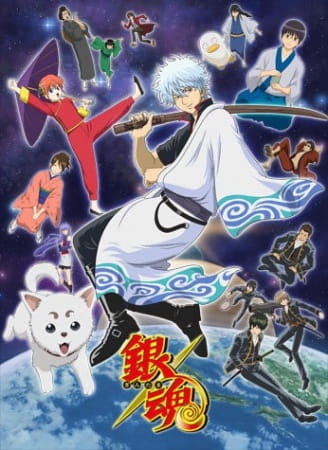
Gintama
Where to watch
Summary
Gintama (2006) is shonen's great tonal experiment: a samurai dramedy that spends three episodes parodying Dragon Ball or making prostate exam jokes, then delivers a brutal flashback to the Joui War that recontextualizes its goofy lead as a war-haunted survivor. Sorachi's writing strength is character density — by season's end, the Shinsengumi, Katsura's rebels, and Kabukicho's residents feel like a lived-in ensemble rather than a hero's supporting cast. Gintoki himself is a quietly radical shonen protagonist: no power-up ladder, no ambition to be the strongest, just a deadbeat with a wooden sword and a fixed moral code. The weaknesses are real, though. The 2006 production is visually unremarkable Sunrise TV work, the first cour is rough as the show finds its voice, the Amanto setting is worldbuilding-thin and exists mostly to enable jokes, and the episodic-to-serialized ratio means viewers must tolerate significant filler to reach payoffs like Benizakura. Within shonen, it's notable for proving that comedy and pathos could coexist at feature length without either undermining the other — a template later series like Mob Psycho 100 would refine.
Criterion breakdown
Story & narrative
Gintama's structure is unusual for shonen: long stretches of episodic parody punctuated by serialized arcs like Benizakura, Yoshiwara in Flames, Kabukicho Four Devas, Shogun Assassination, and the Farewell Shinsengumi Arc. The whiplash between toilet humor and genuinely well-plotted samurai drama is the show's signature trick, though the 2006 run drags in its first cour before finding rhythm, and some filler episodes are pure padding.
Character writing & growth
Sorachi's gift is making side characters — Hijikata, Okita, Katsura, Sakamoto, Tsukuyo — feel as fleshed out as the Yorozuya trio. Gintoki's slow reveal as a Joui War survivor across the Benizakura and Shiroyasha flashbacks recontextualizes his lazy deadbeat persona, while Shinpachi and Kagura's growth is gradual rather than power-creep driven. The huge cast is a strength, though minor Amanto-of-the-week characters often vanish without payoff.
Themes & emotional resonance
The show is genuinely about loss — of a country, of comrades, of a way of life — filtered through a protagonist who refuses to romanticize the samurai code he still embodies. Episodes like the Hasegawa-centric Madao arcs and Otose's backstory in the Kabukicho arc carry real weight. The 2006 season hasn't yet reached the emotional peaks of later arcs, so resonance here is strong but not fully realized.
World-building & power system
The alien-occupied Edo premise is a clever genre mashup — chonmage samurai with flip phones and UFOs — but the Amanto are more a comedic device than a coherent worldbuilding system, with species and tech rules invented per gag. There's no real power system; swordsmanship is vaguely scaled, and Kagura's Yato heritage is the closest thing to mechanical lore in this run.
Animation & direction
Sunrise's 2006 production is functional rather than impressive — flat color work, limited animation in dialogue scenes, and a budget clearly reserved for action setpieces like the Benizakura fight. Director Shinji Takamatsu's comedic timing, freeze-frames, and fourth-wall-breaking title cards do more heavy lifting than the actual draftsmanship, which looks dated next to contemporaries like Bleach.
Cultural impact
Gintama became Jump's premier parody institution, with a devoted fanbase that sustained it across multiple series reboots, films, and a live-action adaptation. Its meta-humor and willingness to mock Jump itself (Bleach, One Piece, Naruto are all targets) influenced how comedy shonen could position themselves, though its dense Japanese cultural and political references limited Western mainstream penetration compared to its big-three peers.
Synopsis (from MAL)
Edo is a city that was home to the vigor and ambition of samurai across the country. However, following feudal Japan's surrender to powerful aliens known as the "Amanto," those aspirations now seem unachievable. With the once-influential shogunate rebuilt as a puppet government, a new law is passed that promptly prohibits all swords in public. Enter Gintoki Sakata, an eccentric silver-haired man who always carries around a wooden sword and maintains his stature as a samurai despite the ban. As the founder of Yorozuya, a small business for odd jobs, Gintoki often embarks on endeavors to help other people—though usually in rather strange and unforeseen ways. Assisted by Shinpachi Shimura, a boy with glasses supposedly learning the way of the samurai; Kagura, a tomboyish girl with superhuman strength and an endless appetite; and Sadaharu, their giant pet dog who loves biting on people's heads, the Yorozuya encounter anything from alien royalty to scuffles with local gangs in the ever-changing world of Edo. [Written by MAL Rewrite]