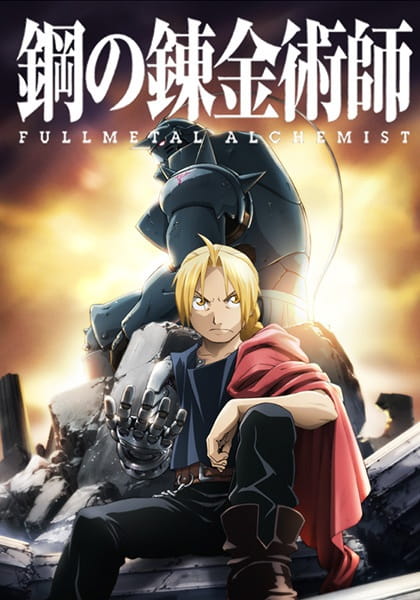
Fullmetal Alchemist: Brotherhood
Where to watch
Summary
Fullmetal Alchemist: Brotherhood is the benchmark by which complete, manga-faithful shonen adaptations are measured. Its strengths are structural: a finished story plotted with foreshadowing that pays off, a villain hierarchy whose members feel individuated rather than power-scaled, and a willingness to engage with genocide, state violence, and grief at a level most shonen avoid. Edward and Alphonse function as genuine co-leads rather than protagonist-and-sidekick, and the supporting cast — Mustang's unit, the Armstrongs, Scar, Hohenheim — carries subplots that intersect meaningfully with the main arc. Weaknesses exist: the first ten episodes compress emotionally heavy material too quickly for viewers without manga context, the animation while consistent rarely reaches the directorial heights of its peers, and Father as final antagonist is more thematic device than compelling character compared to the Homunculi beneath him. The Equivalent Exchange thesis is also occasionally over-explained in late monologues. Still, within shonen conventions, it executes nearly every category at a high level simultaneously, which is rarer than excelling at one. It remains the show newcomers are pointed toward, and the reasons for that recommendation hold up.
Criterion breakdown
Story & narrative
The narrative benefits enormously from adapting a completed manga, with the Ishvalan War flashbacks, the Promised Day buildup, and the convergence of Mustang's coup with the Elrics' quest demonstrating tight plotting rare in shonen. Minor weakness: the opening 10 episodes speedrun material the 2003 anime handled with more weight, making Nina Tucker's arc feel rushed despite its punch. The ending ties off nearly every thread, though Father as a final villain leans more conceptual than personal.
Character writing & growth
Edward's arc from arrogant prodigy to someone who renounces alchemy entirely is earned, and Scar's evolution from vengeful zealot to reluctant ally during the northern arc is one of shonen's better redemption tracks. The Homunculi are unusually well-differentiated — Greed's two incarnations, Hohenheim's quiet grief, and Roy's vengeance against Envy stand out — though side figures like Olivier Armstrong arrive fully-formed without much interior growth.
Themes & emotional resonance
Equivalent Exchange functions as both magic rule and moral thesis, and the show genuinely interrogates it — Ed's final sacrifice of his Gate inverts the premise meaningfully. The Ishvalan genocide treatment, Hughes' death, and Mustang's torture of Envy give the show real moral weight uncommon in shonen, though the 'don't despair, keep moving forward' messaging occasionally tips into didactic territory in late monologues.
World-building & power system
Amestris as a quasi-industrial European state with alchemy as licensed state science is a sharper setting than most shonen battlegrounds, and the Xerxes/Xing parallel cultures add genuine geopolitical texture. The alchemy system's transmutation-circle logic with hard costs is genuinely constrained, though the late reveal of Father drawing on continental human sacrifice somewhat overrides the elegant smaller-scale rules established earlier.
Animation & direction
Bones delivers consistent quality across 64 episodes with standout sequences in Mustang vs. Lust, the Greed/Ling fight, and the Promised Day battles, though much of the middle stretch is workmanlike rather than spectacular. Director Irie's pacing is efficient but the visual style is more functional than distinctive — compare to contemporaries like Kyoto Animation work and the direction reads as solid rather than auteurist.
Cultural impact
Sits atop MAL's rankings for over a decade and serves as the default 'gateway shonen' recommendation alongside Hunter x Hunter. Its influence on later 'complete adaptation' projects and the conversation around manga-faithful remakes is significant, and Hughes/Nina remain reference points for shonen emotional beats.
Synopsis (from MAL)
After a horrific alchemy experiment goes wrong in the Elric household, brothers Edward and Alphonse are left in a catastrophic new reality. Ignoring the alchemical principle banning human transmutation, the boys attempted to bring their recently deceased mother back to life. Instead, they suffered brutal personal loss: Alphonse's body disintegrated while Edward lost a leg and then sacrificed an arm to keep Alphonse's soul in the physical realm by binding it to a hulking suit of armor. The brothers are rescued by their neighbor Pinako Rockbell and her granddaughter Winry. Known as a bio-mechanical engineering prodigy, Winry creates prosthetic limbs for Edward by utilizing "automail," a tough, versatile metal used in robots and combat armor. After years of training, the Elric brothers set off on a quest to restore their bodies by locating the Philosopher's Stone—a powerful gem that allows an alchemist to defy the traditional laws of Equivalent Exchange. As Edward becomes an infamous alchemist and gains the nickname "Fullmetal," the boys' journey embroils them in a growing conspiracy that threatens the fate of the world. [Written by MAL Rewrite]