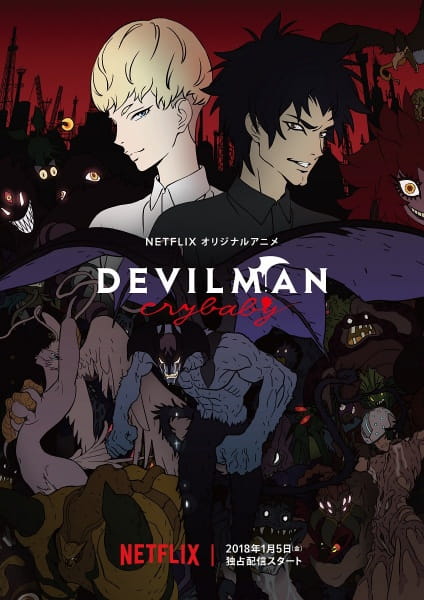
Devilman
Where to watch
Summary
Devilman Crybaby is notable within shonen as a rare adaptation that treats its source material as adult tragedy rather than action vehicle. Masaaki Yuasa's direction transforms Go Nagai's 1972 manga into a propulsive 10-episode meditation on mob violence, queer-coded love, and cosmic futility, anchored by Akira Fudo's evolution from weeping pushover to grief-stricken warrior. The Science SARU animation style — fluid, grotesque, unafraid of nudity or gore — distinguishes it visually from nearly every contemporary shonen adaptation, and Ken Arai's hip-hop score gives it a sonic identity to match. Its thematic ambition, particularly the final episodes' depiction of social media-fueled witch hunts and Ryo's revelation as Satan mourning his beloved, reaches emotional registers shonen rarely attempts. Weaknesses are real: the compression sacrifices Miki Makimura's interiority, the middle episodes juggle subplots unevenly, and viewers unfamiliar with the mythology may find the cosmology underexplained. The mob-hysteria arc, while thematically vital, escalates faster than its setup earns. Still, as a confluence of auteur direction, foundational source material, and streaming-era freedom, it stands as one of the most distinctive shonen-derived works of its decade — flawed, but unmistakably its own.
Criterion breakdown
Story & narrative
Yuasa compresses Nagai's sprawling manga into 10 episodes with remarkable propulsion, building from Sabbath party hedonism to apocalyptic mob hysteria and the Armageddon finale. The middle stretch with Miki's track team and Koda subplot occasionally feels rushed, and Ryo's reveal lands more as inevitability than shock for viewers familiar with the source, but the escalation from personal horror to civilizational collapse is structurally bold for shonen.
Character writing & growth
Akira's transformation from crybaby to devil-bodied protector is genuinely tracked through specific beats — his newfound aggression on the track, his tenderness toward Miki, his despair at Koda's death. Ryo remains compellingly opaque until the final episodes recontextualize him as Satan. Secondary figures like Miki Kuroda and Moyuru Koda get surprisingly affecting micro-arcs, though Miki Makimura herself is more symbol than person until her famous final stand.
Themes & emotional resonance
The show's interrogation of mob psychology — neighbors livestreaming Miki's lynching, witch-hunt hysteria spreading via social media — updates Nagai's 1972 themes with brutal contemporary precision. The love-versus-cosmic-indifference ending, with Ryo weeping over Akira's bisected corpse, achieves a tragic register almost no shonen attempts. Sexuality, violence, and tenderness are treated with rare adult seriousness.
World-building & power system
The devil-host fusion premise remains conceptually rich: power requires moral struggle, and demons embody primal id rather than RPG-style abilities. Yuasa's design work — fluid, biomorphic demon transformations like Silen and Kaim — feels distinct from typical shonen power systems. The cosmology of God, Satan, and cyclical Armageddon is sketched rather than fully developed, which suits the compressed runtime but leaves the mythology thinner than Nagai's original.
Animation & direction
Science SARU's elastic, rubbery animation under Yuasa is unmistakable — the Sabbath rave sequence in episode 1, the rap-battle interludes by Ken Arai's soundtrack, and the apocalyptic crowd scenes all show directorial signature rather than house style. Action is kinetic without being legible-to-a-fault, and color design swings from neon hedonism to washed-out devastation. Some still frames and budget-saving cuts in middle episodes betray Netflix-scale production limits.
Cultural impact
As a high-profile Netflix anime original, it became a gateway for Western audiences to Nagai's foundational work, reigniting discussion of a 1972 property whose DNA runs through Berserk, Evangelion, and Chainsaw Man. Its frank sexuality and violence made it a benchmark for what streaming-era anime could attempt outside broadcast restrictions.
Synopsis (from MAL)
Devils cannot take form without a living host. However, if the will of an individual is strong enough, they can overcome the demon and make its power their own, becoming a Devilman. Weak and unassuming, Akira Fudou has always had a bleeding heart. So when his childhood friend Ryou Asuka asks for his help in uncovering devils, Akira accepts without hesitation. However, to Akira's surprise, the place they go to is Sabbath: an immoral party of debauchery and degeneracy. Amidst bloodshed and death, demons possess the partiers, turning their bodies into grotesque monsters, and begin wreaking havoc. In a reckless attempt to save his best friend, Akira unwittingly merges with the devil Amon and becomes a Devilman, gaining the power to defeat the remaining demons. Though it grants him great power, this new partnership awakens an insatiable and primeval part of Akira. Having the body of a devil but the same crybaby heart, Akira works alongside Ryou, destroying those that harm humanity and his loved ones. [Written by MAL Rewrite]