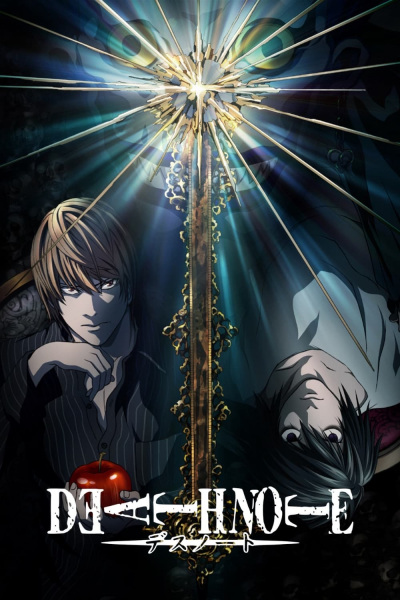
Death Note
Where to watch
Summary
Death Note stands as shonen's premier psychological thriller, demonstrating that the genre could sustain prestige-level tension without conventional combat. Its first half — culminating in episode 25 — is arguably the tightest cat-and-mouse storytelling in anime, anchored by Light and L as two of the medium's most iconic antagonists. Araki's direction transforms what is essentially people thinking in rooms into operatic spectacle, while the Death Note's rule-based power system became a template for constraint-driven plotting. Its themes of justice and corruption are handled with rare moral seriousness for a Shonen Jump property. The show's significant weaknesses are well-documented: the post-L Near/Mello arc cannot replicate the original dynamic, Misa Amane is a frustratingly thin female lead even by 2006 shonen standards, and certain late-game rule revelations feel like authorial cheats. The Yotsuba arc, while clever, is also a noticeable energy dip. Despite these flaws, Death Note's cultural footprint and craft ceiling place it firmly in the upper tier of shonen — not quite definitive of the medium because it consciously rejects many of its conventions, but essential viewing and a benchmark for what cerebral shonen can achieve.
Criterion breakdown
Story & narrative
The first 25 episodes are a masterclass in escalating cat-and-mouse plotting — the bus hijacking gambit, the Lind L. Tailor broadcast, and the Yotsuba arc memory-loss gamble are some of the tightest serialized writing in shonen. However, the post-L arc loses significant momentum; the Near/Mello succession introduces contrived plot mechanics, and the SPK vs. Mafia subplot drags. The ending warehouse confrontation redeems much but cannot fully recover the lost tension.
Character writing & growth
Light's descent from idealistic prodigy to megalomaniacal murderer is meticulously charted — the potato chip scene and his cold dismissal of Naomi Misora demonstrate genuine moral corrosion. L is iconic precisely because of his quirks (sitting posture, sweets obsession) coexisting with deductive brilliance. Weaknesses: Misa is reduced to a love-struck pawn with no real arc, Near is essentially a flatter L-clone, and the Task Force members beyond Soichiro feel functional rather than dimensional.
Themes & emotional resonance
The show interrogates justice, utilitarianism, and the corrupting nature of absolute power without spoon-feeding answers — Soichiro's confrontation with his son's ideology and L's quiet assertion that Kira is 'simply evil' carry real weight. The emotional climax of episode 25 ('Silence') is one of shonen's most resonant moments. It occasionally tips toward thematic repetition in the latter half, restating rather than evolving its moral questions.
World-building & power system
The Death Note's rules function as an exceptionally elegant power system — the constraints (43 seconds, cause of death, face required) generate plot rather than resolve it, which is rare in shonen. The Shinigami realm is intentionally drab and underdeveloped, which works thematically but limits scope. Rule additions late in the series (especially the 13-day rule) feel engineered to enable specific plot beats rather than emerging organically.
Animation & direction
Tetsuro Araki's direction is the show's secret weapon — the operatic 'Light writes names' sequences, dramatic apple-biting framing, and the chiaroscuro lighting in L's confrontations elevate dialogue-heavy scenes into visual theater. Yoshihisa Hirano and Hideki Taniuchi's score (especially 'L's Theme' and the Latin choral pieces) is genre-defining. Animation quality is largely conservative with limited movement, but the storyboarding compensates almost completely.
Cultural impact
Few shonen of its era penetrated global pop culture as thoroughly — it became a gateway anime for Western audiences alongside Naruto and Bleach, spawned live-action films, a Netflix adaptation, and sustained meme literacy nearly two decades later. Its influence on the 'psychological thriller shonen' subgenre (Code Geass, Future Diary) is direct and acknowledged.
Synopsis (from MAL)
Brutal murders, petty thefts, and senseless violence pollute the human world. In contrast, the realm of death gods is a humdrum, unchanging gambling den. The ingenious 17-year-old Japanese student Light Yagami and sadistic god of death Ryuk share one belief: their worlds are rotten. For his own amusement, Ryuk drops his Death Note into the human world. Light stumbles upon it, deeming the first of its rules ridiculous: the human whose name is written in this note shall die. However, the temptation is too great, and Light experiments by writing a felon's name, which disturbingly enacts his first murder. Aware of the terrifying godlike power that has fallen into his hands, Light—under the alias Kira—follows his wicked sense of justice with the ultimate goal of cleansing the world of all evil-doers. The meticulous mastermind detective L is already on his trail, but as Light's brilliance rivals L's, the grand chase for Kira turns into an intense battle of wits that can only end when one of them is dead. [Written by MAL Rewrite]