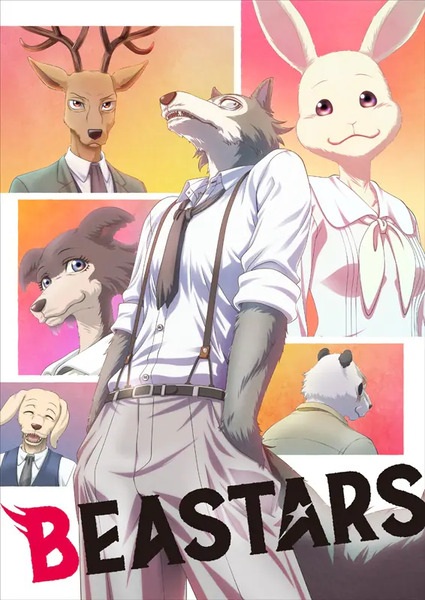
Beastars
Where to watch
Summary
Beastars is a notable outlier in shonen: a Weekly Shonen Champion title that trades tournament structures and power escalation for a psychologically dense meditation on instinct, desire, and social hierarchy. Its strongest asset is Legoshi, a protagonist whose central conflict is internal — whether he can be trusted with his own body — paired with Louis, a rare deuteragonist given equal thematic weight. Orange's CG, often derided in other productions, here becomes a feature, lending physical heft to Legoshi's looming wolf frame and enabling the celebrated stop-motion opening. The show's metaphor system is unusually flexible, mapping onto sexuality, prejudice, and consent without collapsing into allegory. Weaknesses are real, however: Haru is underwritten compared to the male leads, the Black Market detour in the back half tonally fractures the school-mystery setup, and the season ends mid-arc with the Riz storyline barely introduced. As 'power system,' the biological determinism framework limits the action spectacle shonen fans often expect. Within the genre it's a quietly radical work — closer in spirit to seinen psychological drama while retaining shonen's coming-of-age scaffolding — and its limited cultural footprint feels disproportionate to its craft.
Criterion breakdown
Story & narrative
The first season smartly braids a murder mystery, a coming-of-age romance, and a black-market underworld plot into a tight 12 episodes, with the Sumiyaki murder providing narrative spine without dominating. However, the Meteor Festival climax and Riz subplot setup leave threads dangling, and Legoshi's wandering into the Black Market with Louis can feel like an abrupt tonal pivot rather than an earned escalation.
Character writing & growth
Legoshi's arc — from withdrawn stage crew to a wolf actively interrogating his own instincts — is unusually internal for shonen, and Louis is one of the better deuteragonists in recent memory, his herbivore-with-a-Napoleon-complex bravado masking real trauma revealed in the Shishigumi arc. Haru is the weaker link: her aggressive promiscuity is given psychological backstory but she often functions more as a catalyst for Legoshi than as a fully autonomous character.
Themes & emotional resonance
The carnivore/herbivore divide works as a flexible metaphor for sexuality, racial profiling, class, and consent — the scene of Legoshi restraining himself from biting Haru in the courtyard is loaded with all of these at once. The show resists easy moralizing; even Louis's eating of Legoshi's flesh in later material is foreshadowed by a thematic willingness to make 'predation' ambiguous rather than purely evil.
World-building & power system
Cherryton Academy's segregated dorms, size-adjusted infrastructure, and the existence of a Black Market beneath the city give the world genuine texture, and the rule against carnivores eating meat creates believable social friction. The 'power system' is essentially biological determinism vs. willpower, which is thematically rich but means action beats lack the escalation logic of typical shonen — fights are short, ugly, and instinct-driven rather than strategic.
Animation & direction
Orange's CG, often a liability elsewhere, suits the anthropomorphic character designs and allows for the unsettling weight and physicality of Legoshi's wolf body — the OP stop-motion sequence by Dwarf Studios is among the best of the year. Direction by Shinichi Matsumi leans into expressionistic lighting (the auditorium encounter, the alley fight with Riz's bear teammates) though some daytime school scenes look stiff and undercooked.
Cultural impact
Beastars gained meaningful Western traction via Netflix and a vocal furry-adjacent fandom, and it's frequently cited as proof that CG anime can work artistically. Within shonen specifically, though, its footprint is modest — it didn't spawn imitators or shift genre conventions the way contemporaries like Jujutsu Kaisen or Chainsaw Man did.
Synopsis (from MAL)
In a civilized society of anthropomorphic animals, an uneasy tension exists between carnivores and herbivores. At Cherryton Academy, this mutual distrust peaks after a predation incident results in the death of Tem, an alpaca in the school's drama club. Tem's friend Legoshi, a grey wolf in the stage crew, has been an object of fear and suspicion for his whole life. In the immediate aftermath of the tragedy, he continues to lay low and hide his menacing traits, much to the disapproval of Louis, a red deer and the domineering star actor of the drama club. When Louis sneaks into the auditorium to train Tem's replacement for an upcoming play, he assigns Legoshi to lookout duty. That very night, Legoshi has a fateful encounter with Haru, a white dwarf rabbit scorned by her peers. His growing feelings for Haru, complicated by his predatory instincts, force him to confront his own true nature, the circumstances surrounding the death of his friend, and the undercurrent of violence plaguing the world around him. [Written by MAL Rewrite]