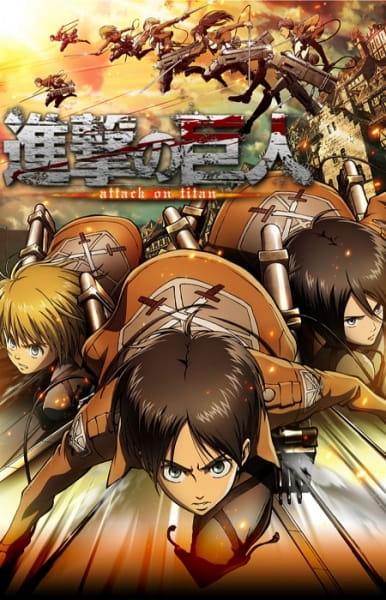
Attack on Titan
Where to watch
Summary
Attack on Titan's 2013 debut season is a landmark entry in modern shonen, notable for weaponizing horror conventions inside a battle-anime framework. Wit Studio's ODM gear animation redefined what television action could look like, and Araki's direction — paired with Sawano's bombastic score — gave the series an operatic intensity that made even establishing shots feel apocalyptic. The walled world and Titan biology offered genuine novelty in a genre prone to recycled power systems, while the willingness to kill named characters created stakes most shonen avoid. Its weaknesses are real: Eren is the least interesting major character in his own show, frequently reduced to screaming exposition while Levi, Erwin, and Armin do the heavier dramatic and tactical lifting. The Female Titan arc's middle stretch leans on flashbacks and slow-motion to pad tension, and the Stohess finale feels rushed compared to Trost's measured build. Thematically, Season 1 only gestures at the moral complexity the manga would later deliver, functioning more as a survival-horror prologue than a complete statement. Still, its cultural footprint — credited with revitalizing global shonen interest in the mid-2010s — makes it one of the most consequential anime debuts of its decade.
Criterion breakdown
Story & narrative
The first season's pacing is exceptional for a 25-episode run, with the Fall of Shiganshina, the Battle of Trost, and the Female Titan arc each building escalating stakes. The mid-season pivot revealing Eren's Titan powers in episode 8 reframes the entire premise. Some weakness emerges in the Stohess arc's compressed pacing and reliance on flashbacks to stretch tension during Annie's reveal.
Character writing & growth
Levi, Erwin, and Hange land instantly as standouts, and the deaths of side cadets like Marco and the 34th squad carry weight because the show actually develops them before killing them. However, Eren himself is the weakest lead — his rage-driven monologuing flattens him compared to Armin's tactical growth or Mikasa's quieter arc, and Season 1 leaves him largely static after his Titan reveal.
Themes & emotional resonance
The show interrogates militarism, the cost of survival, and the dehumanization required to fight monsters — Armin's 'those who can't sacrifice anything can change nothing' line in episode 12 crystallizes this. The emotional resonance peaks with Eren's mother's death and the Levi Squad's slaughter, though Season 1 only hints at the deeper geopolitical themes the manga later explores.
World-building & power system
The walled-city premise with 3D Maneuver Gear creates a genuinely fresh combat system that demands verticality and momentum, distinct from typical shonen power-scaling. Titan biology — the napes, the steam, the mindless grins — is unsettling and original. Season 1 wisely withholds lore, making the world feel oppressively mysterious rather than over-explained.
Animation & direction
Wit Studio's ODM gear sequences, particularly Levi's spin against the Female Titan in episode 22, set a new bar for fluid action choreography in shonen TV anime. Tetsurō Araki's direction leans into operatic horror with Sawano's score, and the colossal Titan's first appearance remains one of the medium's iconic shots. Some later episodes show visible budget strain with static frames and recycled cuts.
Cultural impact
Attack on Titan single-handedly broke shonen out of its early-2010s slump and became the first post-Naruto/Bleach series to achieve genuine global mainstream penetration. 'Guren no Yumiya' became instantly iconic, and the show drove a measurable surge in Western anime adoption and streaming subscriptions.
Synopsis (from MAL)
Centuries ago, mankind was slaughtered to near extinction by monstrous humanoid creatures called Titans, forcing humans to hide in fear behind enormous concentric walls. What makes these giants truly terrifying is that their taste for human flesh is not born out of hunger but what appears to be out of pleasure. To ensure their survival, the remnants of humanity began living within defensive barriers, resulting in one hundred years without a single titan encounter. However, that fragile calm is soon shattered when a colossal Titan manages to breach the supposedly impregnable outer wall, reigniting the fight for survival against the man-eating abominations. After witnessing a horrific personal loss at the hands of the invading creatures, Eren Yeager dedicates his life to their eradication by enlisting into the Survey Corps, an elite military unit that combats the merciless humanoids outside the protection of the walls. Eren, his adopted sister Mikasa Ackerman, and his childhood friend Armin Arlert join the brutal war against the Titans and race to discover a way of defeating them before the last walls are breached. [Written by MAL Rewrite]