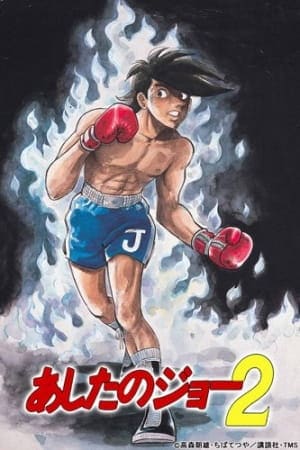
Ashita no Joe
Where to watch
Summary
Ashita no Joe 2 is the rare shonen sequel that surpasses its predecessor by leaning into psychological darkness rather than escalation. Dezaki Osamu's direction transforms a boxing manga adaptation into something closer to tragic theater, with the Carlos Rivera arc functioning as both mentorship narrative and grim prophecy for Joe's own fate. The Jose Mendoza finale—Joe deliberately fighting beyond medical safety to burn himself to ash—remains the genre's most unflinching ending and recontextualizes the entire shonen ethos of 'giving everything' as something genuinely costly rather than triumphant. Character writing is the show's strongest asset: Joe, Danpei, Yoko, Carlos, and Mendoza all carry the weight of real people making real choices. Weaknesses are real but minor: the wandering episodes drag, the Harimao arc is the weakest stretch, and animation quality is inconsistent with heavy reliance on stills during budget-strained bouts. The lack of a speculative power system places it outside the shonen mainstream that emerged later, but within sports shonen and within the medium's emotional range, it sets a ceiling that subsequent works—Hajime no Ippo, Slam Dunk, even Hunter x Hunter's darker turns—have measured themselves against.
Criterion breakdown
Story & narrative
The 1980 sequel series picks up after Rikiishi's death and constructs a remarkably mature arc through Joe's wandering phase, the Carlos Rivera mentorship, and the climactic Jose Mendoza bout. The pacing of the Mendoza buildup—particularly Joe's deteriorating health and the punch-drunk subplot—is exceptional, though the early wandering episodes can feel meandering and the Harimao arc is comparatively weak filler before the final stretch.
Character writing & growth
Joe's evolution from traumatized drifter to a man knowingly walking toward self-destruction is one of shonen's most psychologically rigorous character studies. Carlos Rivera's descent from radiant genius to broken shell is devastating, and Danpei, Yoko, and Mendoza each receive enough interiority to function as full characters rather than foils. The supporting cast (Wolf, Gondo) sometimes exits the narrative too abruptly after serving their thematic purpose.
Themes & emotional resonance
Burning oneself completely white, the dignity of self-chosen ruin, class precarity, and the cost of obsession are explored with a seriousness almost unseen in shonen. The final ash-white image with Mendoza remains the medium's most iconic thematic statement, and Carlos's fate gives that ending its full weight rather than leaving it as empty poetry.
World-building & power system
The slum setting, doya-gai milieu, and 1970s pro-boxing circuit are rendered with documentary specificity that grounds the drama, and the bantamweight weight-cutting becomes a genuine narrative engine rather than flavor. However, as a sports series there is no power system or speculative element, and the world-building is realist rather than inventive by shonen standards.
Animation & direction
Dezaki Osamu's direction—postcard memories, harmonied freeze-frames, expressionist lighting in the Mendoza fight—elevates the production well beyond its TV budget. The fight choreography is intelligible and weighty, though episode-to-episode animation quality fluctuates noticeably and some mid-series bouts rely heavily on still frames and recycled cuts.
Cultural impact
Ashita no Joe is foundational to sports shonen and to anime as a whole; Rikiishi's funeral and the final scene are touchstones referenced across decades of manga and anime. Its association with 1970s student movements and its influence on creators from Urasawa to Morikawa cements its status, even if the 1980 sequel itself is slightly overshadowed in pop-memory by the 1970 original.
Synopsis (from MAL)
Yabuki Joe is left downhearted and hopeless after a certain tragic event. In attempt to put the past behind him, Joe leaves the gym behind and begins wandering. On his travels he comes across the likes of Wolf Kanagushi and Goromaki Gondo, men who unintentionally fan the dying embers inside him, leading him to putting his wanderings to an end. His return home puts Joe back on the path to boxing, but unknown to himself and his trainer, he now suffers deep-set issues holding him back from fighting. In attempt to quell those issues, Carlos Rivera, a world renowned boxer is invited from Venezuela to help Joe recover.